Law
Constitutions, courts and the doctrines judges use to read them.
4 concepts explained · 1 essay guides
Left: closer to domestic politics. Up: closer to theory. Placement is orientation, not judgement.
Placement: Policy Review editors, reviewed October 2026.
Concepts in this field
- Judicial Activism: Definition, Origins and Examples Judicial activism is a label for judges who are more willing than others to strike down laws, overturn precedent or recognize new rights. The…
- Judicial Review: How Courts Check the Other Branches Judicial review is the power of a court to examine a law or a government action and set it aside if it conflicts with…
- Stare Decisis: How Courts Follow Precedent Stare decisis is the legal principle that courts follow their previous decisions when the same legal question comes up again. Lower courts are bound…
- Textualism: Interpreting the Law by Its Text Textualism is a theory of statutory interpretation that holds the meaning of a law is fixed by its text, as an ordinary, informed reader…
Essay guides in this field
Constitutional law deals with the rules that set up a government, divide its power and mark the rights it may not cross. In the United States that means the United States Constitution of 1787, its 27 amendments and more than two centuries of court decisions about what those words require. The explainers and essay guides listed above each take up one part of this field. The five steps below show how they fit together.
Step 1: Learn what constitutional law covers
The Constitution’s first three articles create the legislative, executive and judicial branches, and the remaining provisions deal with the states, with amendment and with federal supremacy. Courses and casebooks usually divide the material into four areas:
- Structure and separation of powers: what Congress, the President and the judiciary may each do, and how they check one another.
- Federalism: the line between the states and the federal government, often fought out under the Commerce Clause of Article I and the Tenth Amendment.
- Fundamental and individual rights: freedom of speech and religion, due process, equal protection and other civil liberties, most of them found in the Bill of Rights (1791) and the Fourteenth Amendment (1868).
- Judicial power itself: who has the final word on what the Constitution means, and when a court should use that power.
Result of this step: you can place any constitutional question in one of four boxes.
What is the difference between constitutional law and statutory law?
A statute is a law passed by a legislature. Constitutional law sits above it. Article VI makes the Constitution, federal laws made under it and treaties “the supreme Law of the Land,” so a statute that conflicts with the Constitution has no force. So constitutional law reaches international questions too: a treaty binds the states, but it must still fit within the Constitution.
Step 2: Find out who interprets the Constitution
Since Marbury v. Madison (1803), American courts have claimed the power of judicial review, the authority to set aside a statute that conflicts with the Constitution. In a concrete case the Supreme Court has the last word, and lower courts follow its rulings.
The other branches interpret the document too. Presidents veto bills they believe are unconstitutional, Congress debates the limits of its own authority, and state courts read their state constitutions on their own terms.
Article V gives a slower route. An amendment needs a two-thirds vote in both houses of Congress, or a convention called on the application of two-thirds of the state legislatures, and then ratification by three-fourths of the states. The full procedure is in the National Archives transcript of the Constitution. Formal amendment has been rare, so most change in constitutional law has come through the Supreme Court and the lower courts.
Result of this step: you know why the method judges use to read the text carries political as well as legal weight.
Step 3: Compare the schools of interpretation
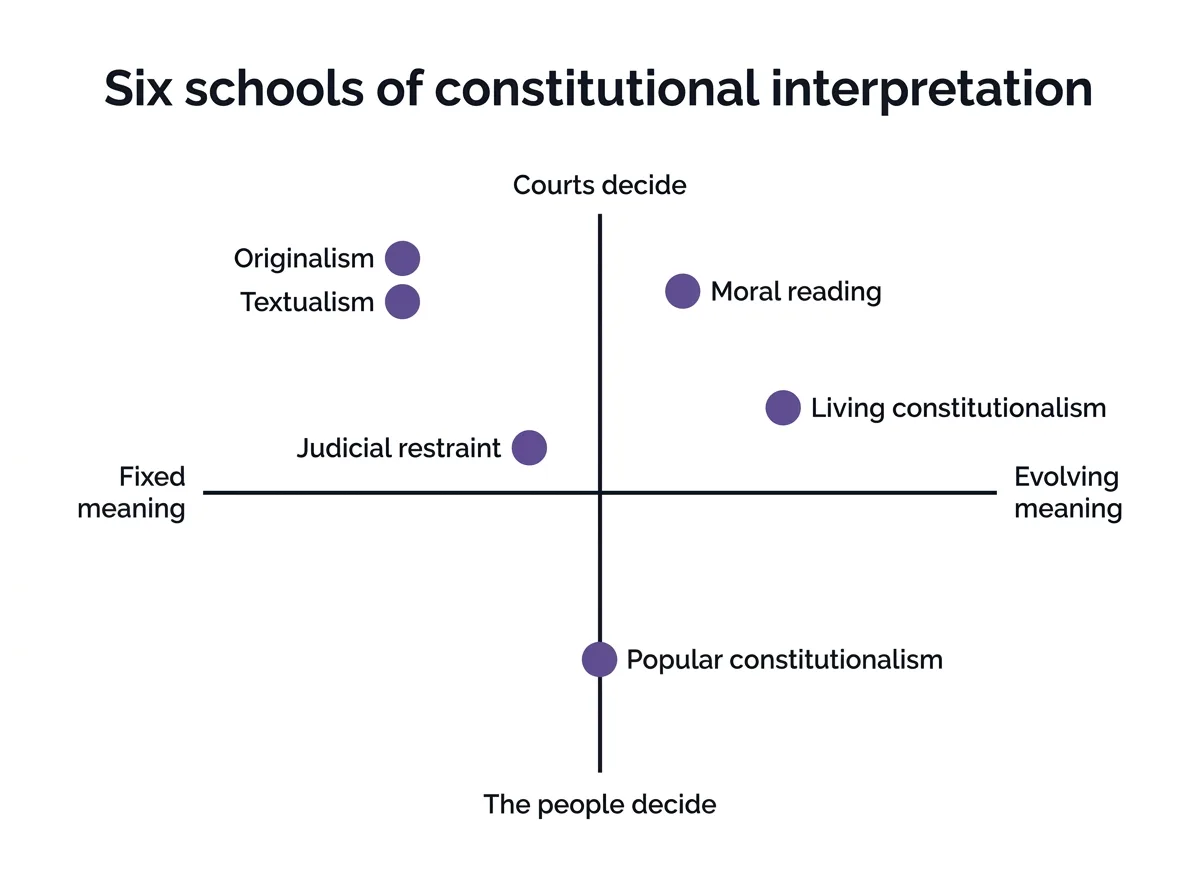
Nearly everyone agrees the Constitution binds; the fight is over how to read it. Each school below answers the same question: when the words leave room, what should a judge look at?
| School | Core claim | Main sources | Associated thinkers | Usual criticism |
|---|---|---|---|---|
| Originalism | Meaning was fixed when a provision was adopted | Text, ratification debates, usage of the time | Robert Bork, Antonin Scalia | Original meaning can be hard to recover |
| Textualism | The words, read as an ordinary reader would, control | Text, dictionaries, structure | Antonin Scalia | Words can be read many ways |
| Living constitutionalism | Meaning develops with circumstances and values | Precedent, tradition, consequences | David Strauss | Gives judges too much discretion |
| Judicial restraint | Laws should fall only in clear cases | Text, deference to legislatures | James Bradley Thayer | May leave rights unprotected |
| Moral reading | Broad clauses state principles that need moral judgment | Principles, fit with past law | Ronald Dworkin | Turns judges into philosophers |
| Popular constitutionalism | Citizens, not only courts, settle meaning | Public debate, elections, amendment | Larry Kramer | Unclear how disputes get resolved |
Originalism and textualism
Originalists hold that a provision means what it meant to the public when it was ratified, which puts the Bill of Rights in 1791 and the Fourteenth Amendment in 1868. Their main argument is democratic. Only the people, through amendment, may change the supreme law, so a judge who updates it claims a power no judge holds. Robert Bork made this case in The Tempting of America.
Textualism is a close relative. Justice Scalia set out the method in A Matter of Interpretation (1997): judges read the words in their ordinary sense and in context, and they do not search for unstated intentions. The site’s explainer on textualism covers the method in statutes as well as in the Constitution.
Living constitutionalism
Living constitutionalists point out that the framers chose broad terms such as “due process” and “unreasonable searches” on purpose. David Strauss argues in The Living Constitution (2010) that American constitutional law works mostly like the common law, with courts building on precedent case by case as the country changes. Supporters most often cite Brown v. Board of Education (1954). Critics reply that without a fixed anchor, the outcome depends on who sits on the bench.
Restraint, the moral reading and popular constitutionalism
Three further positions cut across that divide. James Bradley Thayer argued in 1893 that courts should void a law only when its error is “so clear that it is not open to rational question.” Ronald Dworkin’s moral reading, set out in Freedom’s Law (1996), treats the broad clauses as principles of justice for judges to interpret in their best light. Larry Kramer’s The People Themselves (2004) argues that ordinary citizens, and not courts alone, were meant to have the final say.
Result of this step: you can tell which method a judge is using and how its critics answer.
Step 4: Study the key concepts on this site
Each explainer in the law section takes up one idea the schools above disagree about. A sensible reading order:
- Judicial review: how the power arose in Marbury v. Madison and what limits it.
- Stare decisis: why courts follow precedent and when they overrule it, a question at the center of the living constitution debate.
- Textualism: reading statutes and constitutional clauses by their words.
- Judicial activism: a contested label for decisions that seem to go beyond the law, with its origins and examples.
The essay guides add case material. Benjamin Wittes’s essay on cruel and unusual punishment asks whether the Eighth Amendment test of “evolving standards of decency,” used since Trop v. Dulles (1958), gives judges any stable rule, and proposes reading the words themselves instead.
Step 5: Connect law to the other fields
Questions of constitutional power come up in every other area of public policy:
- Foreign policy and security. Congress declares war, while the President is commander in chief. Justice Jackson’s concurrence in Youngstown Sheet & Tube Co. v. Sawyer (1952) is still the usual framework for judging presidential power in a crisis.
- Economy and society. The Commerce Clause decides how far federal regulation reaches. The move from Lochner v. New York (1905) to West Coast Hotel v. Parrish (1937) and Wickard v. Filburn (1942) made room for the modern regulatory state.
- Ideas. Debates over a republic versus a democracy, and over political representation, turn on how much power the Constitution keeps away from simple majorities.
- Policy analysis. A program that cannot survive a constitutional challenge is not a workable option, so legal feasibility is one of the first tests any proposal faces.
Why are there so many readings of the same text?
Every school in the table has serious defenders on the bench and in law faculties, and each responds to a real concern. Originalists worry about judges who rule by preference. Living constitutionalists worry about a document that cannot answer new problems. Advocates of restraint distrust courts that override elected majorities, while their opponents distrust majorities that override rights.
The articles listed above try to present each view in terms its own supporters would accept, and to keep what the Supreme Court and other courts actually held apart from what commentators think they should have held.