The essay in brief
In "The Future of Tradition" (Policy Review, 2005), Lee Harris argued that traditions live as felt codes of behavior passed on by families and shining examples, not as claims that reason can prove or refute. He concluded that turning marriage into an open debate would erode its ethical obviousness.

Can you defend a tradition by giving arguments for it? Lee Harris thought the attempt was a trap. In “The Future of Tradition,” published in *Policy Review* No. 131 (June and July 2005), he argued that conservatives who answer their critics with rational proofs have already given away the most important point.
Harris was then known for *Civilization and Its Enemies* (2004), a book about the September 11 attacks. This essay turned to the culture war at home and ended with a case against same-sex marriage. This guide breaks it into seven ideas, then turns to the critics and how it reads in the present.
1. Every culture war puts custom on trial
Harris opened with a sweeping claim. The West has fought at least three great culture wars: in Greece at the time of the Sophists, in the French Enlightenment, and in America now. In each one, those who are skilled in abstract argument called inherited habits before the bar of logic and asked whether they could be justified.
He thought the first two ended badly for the societies involved. The third was still undecided.
2. Reason wins every round it is allowed to fight
The puzzle comes early. Moses Maimonides, the twelfth-century philosopher, defended the dietary laws of Leviticus as sound medical advice.
That looks like a win for tradition. Harris saw a defeat. If a custom is just science in code, a good nutrition manual would make it unnecessary. If it conflicts with science, it loses anyway. Either way, reason wins and the tradition loses.
He added a second problem: cultural relativism. If every culture’s practices are right for that culture, nobody may condemn even the cruelest practice abroad. By the same logic, the relativist cannot condemn the traditionalists at home either.
3. Three famous defenses of tradition that Harris rejects
Harris then tested the main defenses of tradition that have been offered over the centuries and rejected all three.
| Defense | The claim | Harris’s objection |
|---|---|---|
| Useful fiction | Myths keep ordinary people in line while an elite knows the real purpose (Plato’s noble lie, later Leo Strauss) | It splits society into the knowing few and the deceived many |
| Skepticism | No one is wise enough to know which habits a society may safely drop (a secular form of Burke) | It defends traditions in general but no particular one |
| Evolution | Practices that survive have proven themselves, as in Friedrich Hayek’s *The Constitution of Liberty* | Almost no tradition wipes out its community, so the test approves nearly everything |
On Hayek, he borrowed Karl Popper’s fable of villagers who believed tigers were harmless and were eaten. Then he changed the story: suppose they knew tigers were dangerous and followed a sacred rule never to resist. A false belief can be refuted. A command does not work that way.
4. Traditions are commands before they are claims
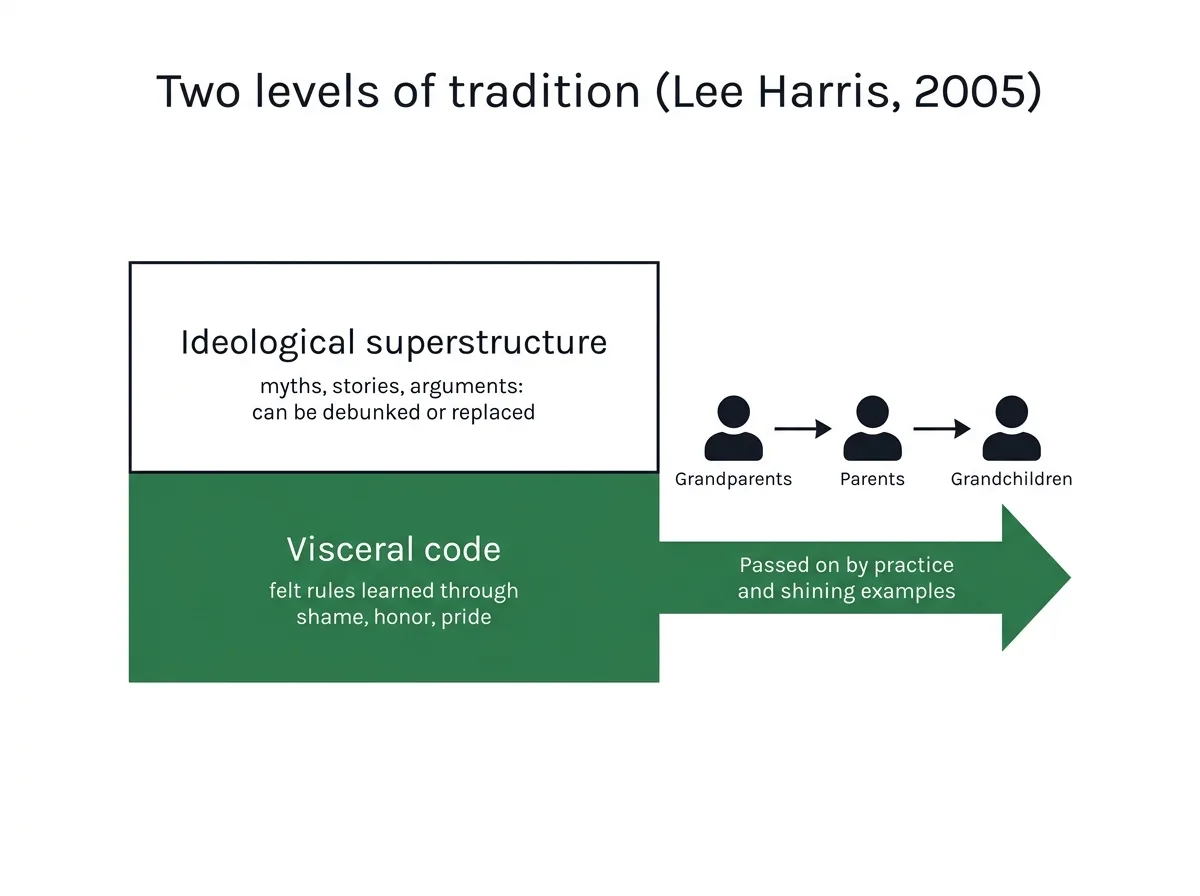
All three defenses, Harris argued, treat the tradition as a set of statements that are true or false. He called this the “declarative fallacy.” In his view there are two levels in every tradition:
- The visceral code: the felt rules, passed on through shame, honor and pride, that make people act without thinking.
- The ideological superstructure: the myths, stories and arguments a community uses to explain those rules.
His example was an incest taboo justified by a silly myth. The myth may be debunked while the taboo keeps doing its work. The danger comes when parents who no longer believe the story stop teaching the rule.

5. A tradition is a recipe, not a theory
If traditions are not claims, how should we judge them? Harris proposed treating them as recipes. A recipe is neither true nor false. It tells you what to do for a certain result, and it leaves room to vary the details.
That still sounds relativist, and Harris admitted the risk. His answer was that people are able to compare their own before and after. A person knows whether he likes who he has become, and a society may judge the same way. Meiji Japan adopted Western institutions on purpose and weighed the results from the inside.
6. Civilization lasts through grandchildren and shining examples
The most striking idea concerns time. A civilization, Harris argued, survives only if each generation feels a duty to the third: the grandchildren. Handing down the good china is not enough. You must also pass on the recipe for the meal, the cook, and the cook’s sense that he must train the next one.
In his view the family does this better than any state, and it works through what he called the “shining example.” This is a real person who feels ordinary weakness and rises above it, like a soldier who masters fear. Abstract ideals such as “be tolerant” give a child no picture of how to act. A living model does. He also blamed the modern gospel of self-esteem for killing the wish to become like someone better.
7. The marriage debate as a test case
The final section applied all this to same-sex marriage. The gut response many people had to the idea, Harris argued, was the code doing its job and not mere prejudice. Once marriage became a subject of debate, it lost its “ethical obviousness,” the protective quality of something nobody thinks to question.
He wrote this as a gay man and said so in the text. He thanked parents who raised him with traditional values and urged gay men and women to build their own shining examples instead of taking over an institution they had left. His sharpest words were aimed at intellectuals, whom he accused of opening to debate what had never been debated.
Context and reception
The essay appeared months after a wave of state ballot measures on marriage in 2004, while Canada was moving toward legal same-sex marriage. He quoted, more than once, a phrase he attributed to the chief justice of Canada’s Supreme Court: opposition rested on “residual personal prejudice.”
Some of the sharpest responses came from fellow conservatives:
- Stanley Kurtz at *National Review* praised the essay as a deep critique of same-sex marriage.
- R. Albert Mohler Jr., president of the Southern Baptist Theological Seminary, called the recipe idea an “odd and rather superficial defense.” Without a transcendent standard, he wrote, Harris slid back into the relativism he attacked.
- A commenter on the Patterico blog asked whether the title fit the content and whether Harris was fair to Hayek, whose idea of spontaneous order he barely mentions.
Supporters of same-sex marriage would reject his premise outright: that a rule feeling obvious is evidence it should stay. Critics also note that the essay offers no data on how families actually fare.
How has the argument held up?
On the legal question, U.S. law moved away from the essay’s conclusion. In 2015 the U.S. Supreme Court ruled in Obergefell v. Hodges that states must license and recognize same-sex marriages. In 2022 Congress passed the Respect for Marriage Act.
The theory is another matter. Debates about trust in institutions, the loss of shared social norms and the family’s role in forming character are still live on the political left and right, well beyond the world of American conservatism. Some readers who reject his conclusion still discuss his split between the felt code and the stories told about it.
Readers’ questions
What is the essay’s main claim?
Traditions are passed on as felt habits, not arguments, so defending them with logic alone hands the critics the field.
Who is Lee Harris?
An American essayist, author of *Civilization and Its Enemies* and later *The Suicide of Reason*.
What is ethical obviousness?
The state in which a practice is so taken for granted that no alternative comes to mind.
Does Harris reject reason?
No. He calls it noble but argues that some questions damage a community simply by being asked.
Where to read the original
The full text of “The Future of Tradition” is available in the Hoover Institution’s Policy Review archive. The sections on Hayek and the shining example repay a slow read.
Sources
- Lee Harris, "The Future of Tradition", Policy Review 131 (2005)
- R. Albert Mohler Jr., "Can We Live Without Tradition? Part One", Christian Post (2005)
- Patterico's Pontifications: A long-awaited essay (2005)
- Obergefell v. Hodges, 576 U.S. 644 (2015), LII
- Friedrich A. Hayek, The Constitution of Liberty (University of Chicago Press, 1960)