The essay in brief
In 2005 Stanley Kurtz argued that falling birth rates would strain the welfare state and force cultural change. He saw two possible paths: a turn back toward the family and more conservative values, or a technological break with the traditional family that he called a new eugenics.

Stanley Kurtz came at American politics through the birth rate. In “Demographics and the Culture War,” published in *Policy Review* No. 129 (February and March 2005), he started from a fact that rarely made the front page: almost every rich country was having too few babies to replace its population.
He then asked what that would mean for the fights over marriage, religion and sex that had divided America since the 1960s. If modern life produces ever smaller families, can it last, and which way does opinion bend when it can’t?
This guide sets out his answer, compares it with the rival forecast from the left, and asks how both have held up.
The argument in brief
Kurtz wrote the piece as a review of four new books:
- *The Empty Cradle* by Phillip Longman
- *Fewer* by Ben Wattenberg
- *The Coming Generational Storm* by Laurence Kotlikoff and Scott Burns
- *Running on Empty* by Peter G. Peterson
His reading of them runs in three steps.
- The numbers. The average woman needs to have about 2.1 children for a country to hold the population steady. In 2005 no nation in the industrialized world reached that level, and fertility rates have been dropping fast in much of the developing world too. Kurtz cited UN estimates that by 2050 about 42 percent of people in Italy and Japan would be 60 or older. Immigration, he argued, could not close the gap at any level voters would accept.
- The economy. Pay as you go pensions and health programs assume each generation is larger than the one before. With fewer young workers, Social Security and Medicare face a funding gap that the government cannot close without pain. Kurtz added a twist the economists mostly skipped: rising taxes on families make raising kids more expensive, which deepens the decline.
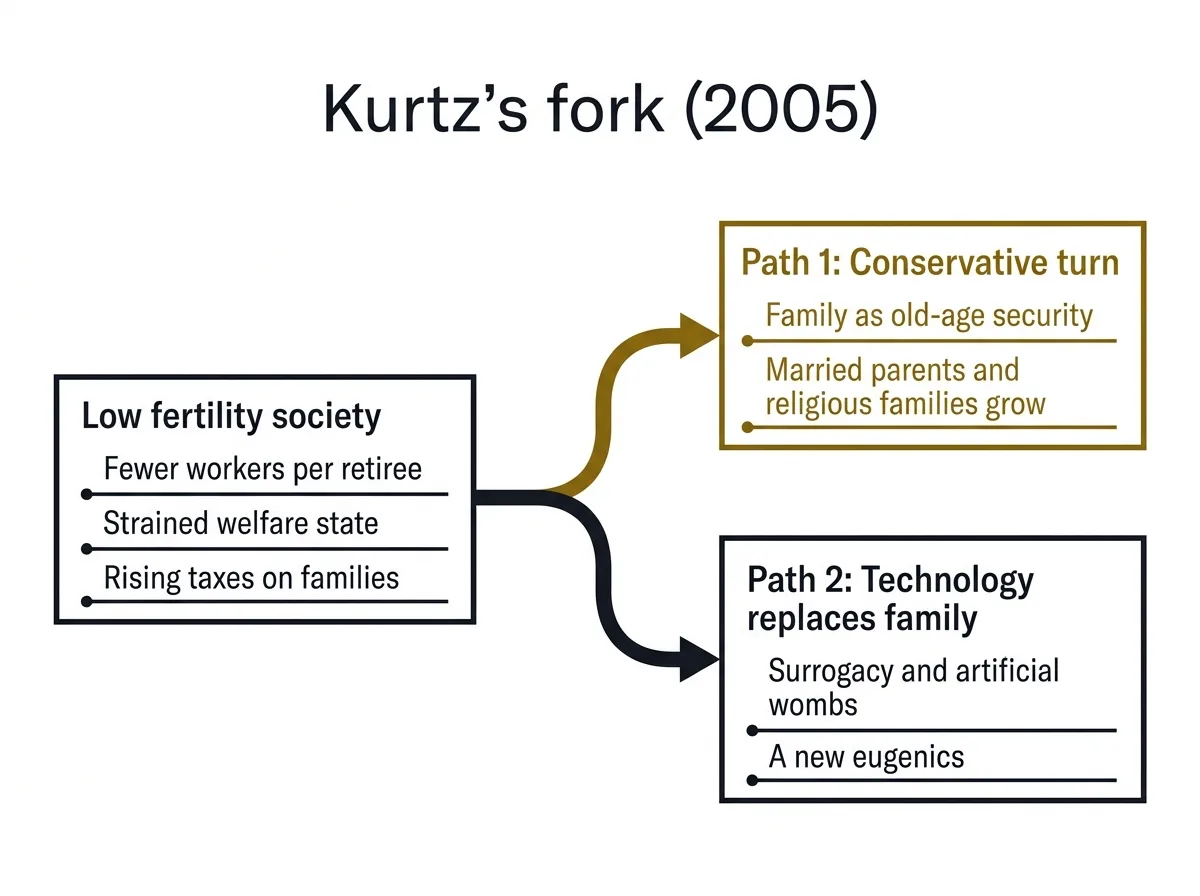
- The fork. Low fertility, he argued, is bound up with city life, contraception, women’s careers, secularism and individualism. If a low fertility society can’t sustain itself, something in that bundle has to give, and the cultural fight over the family is where that would be settled.
Two futures Kurtz compared
Kurtz laid out two possible paths, drawing on the sociologist David Popenoe’s book *Disturbing the Nest*, which had sketched how the Western household might either recover or dissolve further.
Path one is a conservative turn. If the welfare state weakens, people may again rely on their sons and daughters for security in old age, and starting a family looks like a practical necessity again. Married parents, Kurtz noted, tend to be more conservative. Religious traditionalists also have larger families than secular liberals. Longman, himself a secular liberal, feared exactly this and wrote that if population did not wither away, “it will be because of a mutation in human culture.”
Path two replaces parts of the family with technology. Building on Francis Fukuyama’s *Our Posthuman Future*, Kurtz argued that in a shrinking world the pressure on future bioengineers would be to produce more people, not better ones. He suggested that some on the cultural left might turn to surrogacy and even artificial wombs to reconcile careers with an adequate number of births, a prospect he called a new eugenics.
Kurtz versus the emerging majority forecast
The essay reads best next to the rival demographic story of those years. Progressive analysts, most prominently John Judis and Ruy Teixeira in *The Emerging Democratic Majority* (2002), argued that the growth of young, urban, educated and nonwhite voters would favour the Democratic Party. Kurtz knew this argument and turned it around: forecasts of Democratic dominance, he wrote, rested partly on the rising share of single women, who have fewer kids.
| Question | Kurtz (2005) | Emerging majority view (Judis and Teixeira, later Teixeira 2009) |
|---|---|---|
| Which trend matters most? | Falling fertility and an aging population | A more diverse, younger, more educated electorate |
| What happens to social issues? | Strain on the welfare state may revive the household and push opinion right | Younger voters are more tolerant, so the old wedge issues (gay marriage, abortion) lose force |
| Who gains politically? | Married parents and religious traditionalists, over time | Progressives and the Democratic Party |
| Main uncertainty | Whether people will change behaviour that rests on personal choice | Whether group voting patterns stay fixed |
In 2009 Teixeira went further in a report for the Center for American Progress, a progressive think tank, titled “The Coming End of the Culture Wars.” It argued that demographic change was eroding the base of culture war politics, above all because white working class voters, the most socially conservative group, were shrinking as a share of the electorate.
Both camps read the future from population trends. They were simply watching different numbers: Kurtz watched births, Teixeira watched the makeup of the electorate.
Reception and criticism
As a review article, the essay did not set off a formal exchange of replies in the journal. It did travel among religious readers. The Southern Baptist theologian Albert Mohler wrote a commentary on it titled “Demography and the Culture War: A Rightward Shift?”, which was also carried by the *Christian Post*.
The main objections follow from the argument itself, and Kurtz raised several of them:
- People do not have babies to help the country. They follow their own desires and interests, and few free societies would restrict contraception.
- Religious parents having more children is no guarantee those children stay religious.
- Higher productivity, later retirement and entitlement reform could ease the pressure on the economy without any shift in values. Kurtz was sceptical of these fixes but did not rule them out.
- In a 2006 NPR interview, Longman suggested that many social conservatives might end up as Democrats because the party itself would change.
Kurtz also criticised the other authors, arguing that Peterson, Kotlikoff and Burns blamed politicians too much for a problem that demography had created.
How the argument has held up
On the facts, Kurtz was on solid ground. The UN’s World Population Prospects 2024 puts global fertility at 2.25 births per woman, down from 3.31 in 1990, and reports that more than half of all countries and areas are now below the replacement level of 2.1. In the United States the rate has been falling for years and has reached a record low of around 1.6.
On politics, the picture is mixed for both sides.
- The culture war did not end. Teixeira’s 2009 forecast that it would fade has not been borne out so far, and immigration has become one of its main fronts for voters on both the right and the left.
- Falling births have become a political issue in their own right. Pronatalism today is promoted most visibly by parts of the political right, which partly fits Kurtz’s expectation, while many progressives debate their own answers on child care and affordability.
- A broad rightward shift driven by bigger religious families has not clearly happened, and Kurtz’s own caveat applies.
- His darker scenario remains speculative. Surrogacy has grown, but artificial wombs are still a research topic and no government treats them as population policy.
Kurtz closed by saying that “our social order is in motion.” After two decades, that modest version of his claim looks safer than either of the specific futures he sketched.

Questions readers ask
What did Stanley Kurtz argue in this essay?
That declining birth rates threaten the welfare state and economic growth, and that any recovery would likely require a change in values, most plausibly toward the right.
Did Kurtz say the right would win the culture war?
No. He presented a conservative revival as one possible outcome and a technology driven break with the traditional household as another.
Can pronatalist policies raise fertility rates?
Wattenberg doubted it, noting that such policies had generally failed. Kurtz thought they might work under severe economic stress.
Where to read the original
The full essay by Stanley Kurtz, *Policy Review* No. 129 (February and March 2005), is available in the Hoover Institution’s Policy Review archive.
Sources
- Stanley Kurtz, "Demographics and the Culture War", Policy Review 129 (2005)
- Phillip Longman, The Empty Cradle (Basic Books, 2004)
- Ben J. Wattenberg, Fewer: How the New Demography of Depopulation Will Shape Our Future (Ivan R. Dee, 2004)
- Ruy Teixeira, The Coming End of the Culture Wars, Center for American Progress (2009)
- United Nations, World Population Prospects 2024: Summary of Results