Ideas
Ideologies, forms of democracy and the arguments behind them.
7 concepts explained · 7 essay guides
Left: closer to domestic politics. Up: closer to theory. Placement is orientation, not judgement.
Placement: Policy Review editors, reviewed October 2026.
Concepts in this field
- Civil Society: Six Myths and What the Facts Say Civil society is the space of voluntary, organized social life between the family, the market and the state. It includes churches, unions, charities, community…
- Direct Democracy: Six Forms and How They Work in Practice Direct democracy is a form of government in which citizens decide laws and policy questions themselves instead of leaving every decision to elected representatives.…
- Neoconservatism: How Disillusioned Liberals Changed American Conservatism Neoconservatism is an American political current that combines skepticism about ambitious social programs with a confident, often interventionist foreign policy aimed at defending and…
- Political Socialization: How People Learn Their Politics Political socialization is the process by which people acquire their political values, attitudes, beliefs and habits of participation. It begins in childhood, continues throughout…
- Representative Democracy: A Five-Part Framework for How It Works Representative democracy is a system of government in which citizens elect representatives to make laws and policy on their behalf, instead of voting on…
- Republic vs Democracy: Two Old Words and Why the United States Is Both A democracy is a system in which political authority comes from the people, who rule directly or through elected representatives. A republic is a…
- Socialism vs Communism: The Differences Between Two Ideas Socialism is a system in which the means of production are owned or controlled by society as a whole, often alongside markets and democratic…
Essay guides in this field
- The Future of Tradition by Lee Harris: 7 Ideas Behind the Essay In "The Future of Tradition" (Policy Review, 2005), Lee Harris argued that traditions live as felt codes of behavior passed on by families and…
- The Media and Medievalism: Robert Kaplan on Press Power Robert D. Kaplan argued in 2004 that the global news media had become an unelected, unaccountable power, comparable to the medieval church, that judges…
- The Intellectual Origins of America-Bashing: Lee Harris’s Argument Explained Lee Harris argued in 2002 that the most radical anti-Americanism grew out of a revision of Marxism: when Western workers prospered, theorists such as…
- Allen Drury and the Washington Novel: Roger Kaplan’s Essay Explained Roger Kaplan argued in 1999 that Allen Drury's Advise and Consent (1959) invented the modern Washington novel and remains the one book of the…
- Anti-Semitism and Ethnicity in Europe: John Rosenthal’s 2003 Argument In a 2003 Policy Review essay, John Rosenthal argued that anti-Semitism in Europe was underreported, homegrown rather than simply imported, and echoed by parts…
- Scoop Jackson Democrat: Joseph Lieberman’s 1990 Interview Explained In a 1990 Policy Review interview, Senator Joseph Lieberman argued that Democrats should return to the tradition of Roosevelt, Truman and Kennedy: economic growth…
- Norman’s Conquest: Mark Gerson on the Norman Podhoretz Legacy Writing in Policy Review in fall 1995, Mark Gerson argued that Norman Podhoretz, editor of Commentary from 1960 to 1995, won the battle of…
Political ideologies are organized sets of beliefs and values about how society should be run: who should hold power, what government owes its citizens, and how much weight to give liberty, equality, tradition and community. This section of Policy Review covers the thinking behind public policy. The explainers and essay guides above treat single concepts in depth. The notes below compare the main schools side by side and show where they part ways.
What is a political ideology?
The word began as a neutral term. The French philosopher Antoine Destutt de Tracy coined “idéologie” in the 1790s to mean a science of ideas. Later, partly through Karl Marx, it took on a harsher sense: a distorted worldview that serves a ruling class. Most political science today uses the older meaning, in which almost everyone may hold a political ideology with more or less conviction.
In *Ideologies and Political Theory* (1996), Michael Freeden describes each ideology as a cluster of core concepts, such as liberty for liberalism, surrounded by looser ones that shift with time and place. That is why two people who share a label can still disagree on trade or immigration. Philip Converse added a caution in “The Nature of Belief Systems in Mass Publics” (1964): most American voters did not hold tightly consistent views across issues, while activists and elites usually did.
An ideology is also different from a party. A party platform is written for one election; an ideology is older and broader. Both major parties in the United States are coalitions that draw on several traditions at once.
Political ideologies compared: the main families
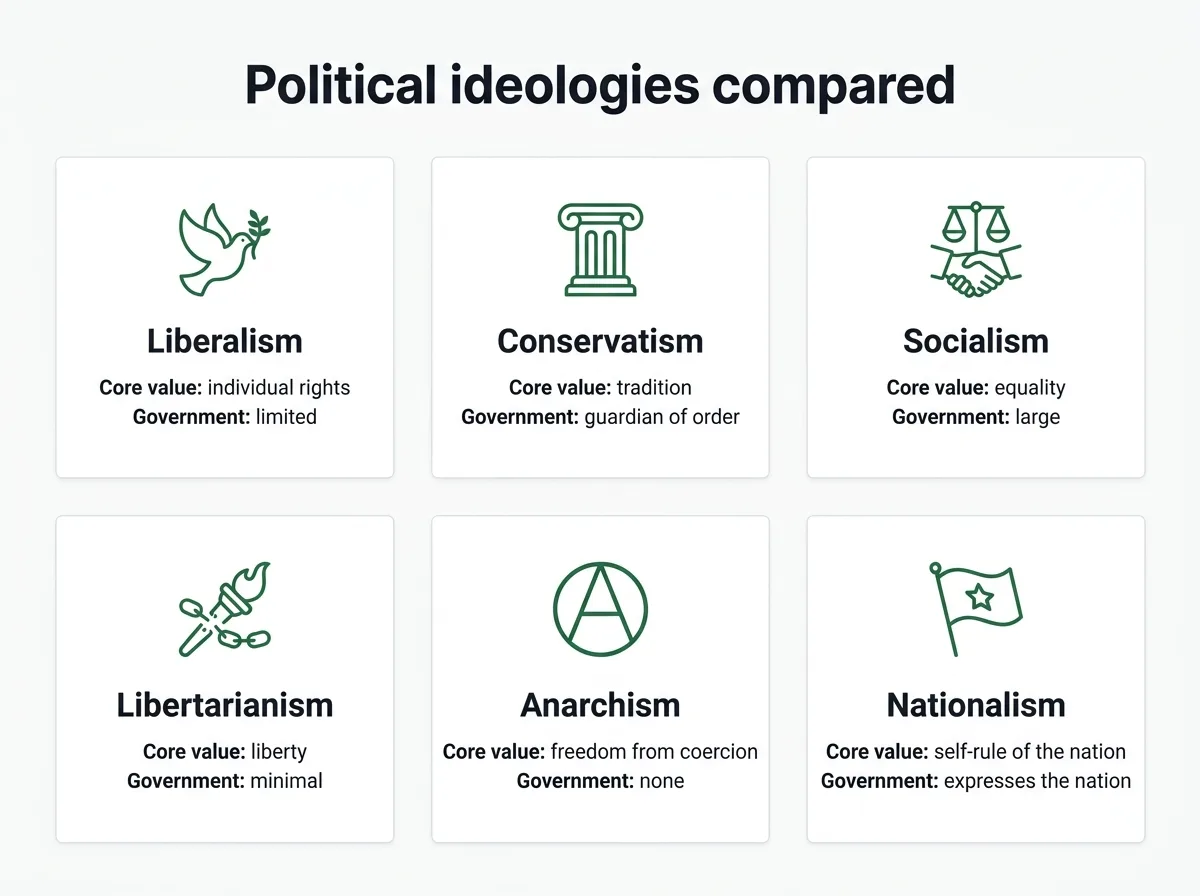
A full list of political ideologies would run to dozens of entries. The table covers the ideologies that have had the most influence, each described in the terms its own defenders would use.
| Ideology | Core value | Role of government | Economic view | Classic text |
|---|---|---|---|---|
| Liberalism | Individual rights and consent | Limited, protects rights | Classical: free markets; modern: regulated markets | John Locke, *Two Treatises of Government* (1689) |
| Conservatism | Tradition and continuity | Guardian of order and inherited institutions | Usually pro-market, wary of rapid change | Edmund Burke, *Reflections on the Revolution in France* (1790) |
| Socialism | Equality and solidarity | Large, often owns or directs key industries | Social ownership of the means of production | Marx and Engels, *The Communist Manifesto* (1848) |
| Social democracy | Equality through elections | Strong welfare system | Market economy with redistribution | Eduard Bernstein, *Evolutionary Socialism* (1899) |
| Libertarianism | Self-ownership and liberty | Minimal | Free markets, few regulations | Robert Nozick, *Anarchy, State, and Utopia* (1974) |
| Anarchism | Freedom from coercion | None; government is seen as harmful | Varies from collective to individualist | Pierre-Joseph Proudhon, *What Is Property?* (1840) |
| Nationalism | Self-rule of the nation | Expresses the national community | Varies widely | Giuseppe Mazzini’s writings on Italian unity |
| Feminism | Equal standing for women | Varies by strand | Varies by strand | Mary Wollstonecraft, *A Vindication of the Rights of Woman* (1792) |
| Environmentalism | Protection of the natural world | Regulator of environmental harm | Growth limited by ecology | Rachel Carson’s *Silent Spring* (1962) is often cited |
Liberalism vs conservatism in American politics
Classical liberalism, from Locke onward, stresses individual rights, the rule of law and limits on government power. Modern American liberalism, whose left wing often calls itself progressive, keeps that commitment but accepts a larger public role in reducing social and economic inequality, which puts it on the center-left. Liberalism and liberal democracy are often treated as one, though the second term names a system of government: elected rule with protected rights.
Burke argued that institutions built up over generations hold practical wisdom no single plan can match, so reform should be gradual. Conservatives tend to defend religious institutions, the family and local community, and many American conservatives also defend free markets.
The meanings drift around the world. In much of Europe a “liberal” party stands for free markets and civil liberties, closer to what Americans call classical liberal. A British conservative defending the monarchy and an American conservative defending the Constitution are guarding different inheritances. Neoconservatism, covered in its own explainer here, shows how a group of disillusioned liberals joined the conservative movement in the 1960s and 1970s.
Socialism, communism and social democracy
These three share a criticism of capitalism and a common history in the nineteenth-century labor movement. They differ on method and on how far change should go.
- Communism, in Marxist theory, is the final stage: a classless society without private property. In practice the word came to describe one-party regimes such as the Soviet Union.
- Socialism in the Marxist scheme was the stage before communism. Many socialists, though, chose elections and parliaments, and democratic socialism advocates for the same goal of social ownership through the ballot box.
- Social democracy accepts a market economy and seeks equality through taxes, public services and labor protections. Social democratic parties in Scandinavia built large welfare systems this way.

Libertarianism and anarchism: how small can government get?
Both schools put liberty first and distrust concentrated power. The difference is one of degree. Libertarians accept a minimal “night-watchman” state that protects property, enforces contracts and defends the country. Anarchists reject the state altogether. Proudhon, writing in 1840, was the first author to call himself an anarchist. Anarchism has collectivist and individualist strands, so some anarchists sit closer to the socialist left and others to the libertarian right.
Nationalism, populism and feminism
Nationalism holds that a nation should govern itself, usually in a country of its own. It can be civic and open, built on shared citizenship, or ethnic and exclusive, built on descent.
Populism is harder to place. The political scientist Cas Mudde calls it a “thin-centred ideology” that pits “the pure people” against “the corrupt elite” and attaches itself to a fuller ideology. That is why scholars speak of both left-wing populism and right-wing populism.
Feminism and environmentalism grew into broad movements in the twentieth century. Each contains liberal, socialist and more radical strands, and each asks other ideologies to answer new questions: about the family and work in one case, about growth and future generations in the other.
The political spectrum: one line or two?
The left-right spectrum began with a seating plan. In the French National Assembly of 1789, supporters of the king sat to the right of the chair and advocates of radical change to the left. Many analysts use two axes: one economic (planning versus free markets) and one social (order and authority versus personal liberty). On that map a libertarian sits far from both the socialist left and the social conservative right.
Survey research supports the picture of a fractured field. The Pew Research Center’s 2021 political typology sorted 10,221 American adults into nine groups based on their political values, with clear divisions inside both the Democratic and Republican coalitions.
Concepts covered in this section
The explainers here take up questions that run through all of these schools:
- Civil society: the associations, churches and voluntary groups between the individual and the state.
- Republic vs democracy: two old words, and why the United States is both.
- Direct democracy: referendums, initiatives, recalls and town meetings.
- Socialism vs communism: where the two overlap and where they split.
- Neoconservatism: how one intellectual movement changed American conservatism.
How political ideologies connect to the other fields
Ideologies are the foundation for everything else on Policy Review. Each other field applies them to concrete decisions:
- Foreign policy: realism and liberal internationalism disagree about power and international cooperation, which shapes debates over realpolitik and isolationism.
- Law: textualism and “living” readings of the Constitution rest on different views of rights and the role of courts.
- Economy and society: Keynesian economics, supply-side thinking and the welfare state track the old divide between planning and markets.
- Security: views on deterrence and the use of force follow from beliefs about human nature.
- Policy analysis: even methods for weighing costs and benefits carry assumptions about whose interests count.
A debate about a tax, a treaty or a court ruling often turns out to be a debate about political ideologies underneath.