The essay in brief
Mary Eberstadt argued in 2004 that much of the most popular rock and rap around 2000 was about divorce, absent fathers and inattentive parents, and that its huge teenage audience showed how many young people felt the same. When Eminem blamed parents rather than his records, she wrote, he was in that limited sense right.

Picture a fourteen-year-old in 2002, door closed, headphones on. Downstairs, a parent worries about the violence and the slurs on the new album playing upstairs. Many parents shared that worry. Yet the song may also be describing that very house.
This is the puzzle behind “Eminem Is Right,” the essay Mary Eberstadt published in *Policy Review* No. 128 (December 2004 and January 2005). Her claim: once you strip away the shock value, a striking share of the biggest rock and rap of those years deals with children and teenagers who feel left behind by the adults in their lives.
The argument in brief
Eberstadt does not defend the lyrics. Some of the songs are, she grants, darker and coarser than the rock of earlier decades, and she sets aside the long debate over whether violent songs make teens violent. Her question runs the other way: not what the songs do to kids, but what they reveal.
Her case has four steps:
- Listen to the lyrics. Across the top acts a pattern appears: broken homes and checked-out adults and, above all, absent fathers.
- Look at the audience. These were not fringe records. They sold in the millions, and fans wrote to the bands, kid after kid, saying a song was about their own life.
- Trace the dark themes. Suicide, drugs and even misogyny are often tied, by the artists themselves, to what their parents have done.
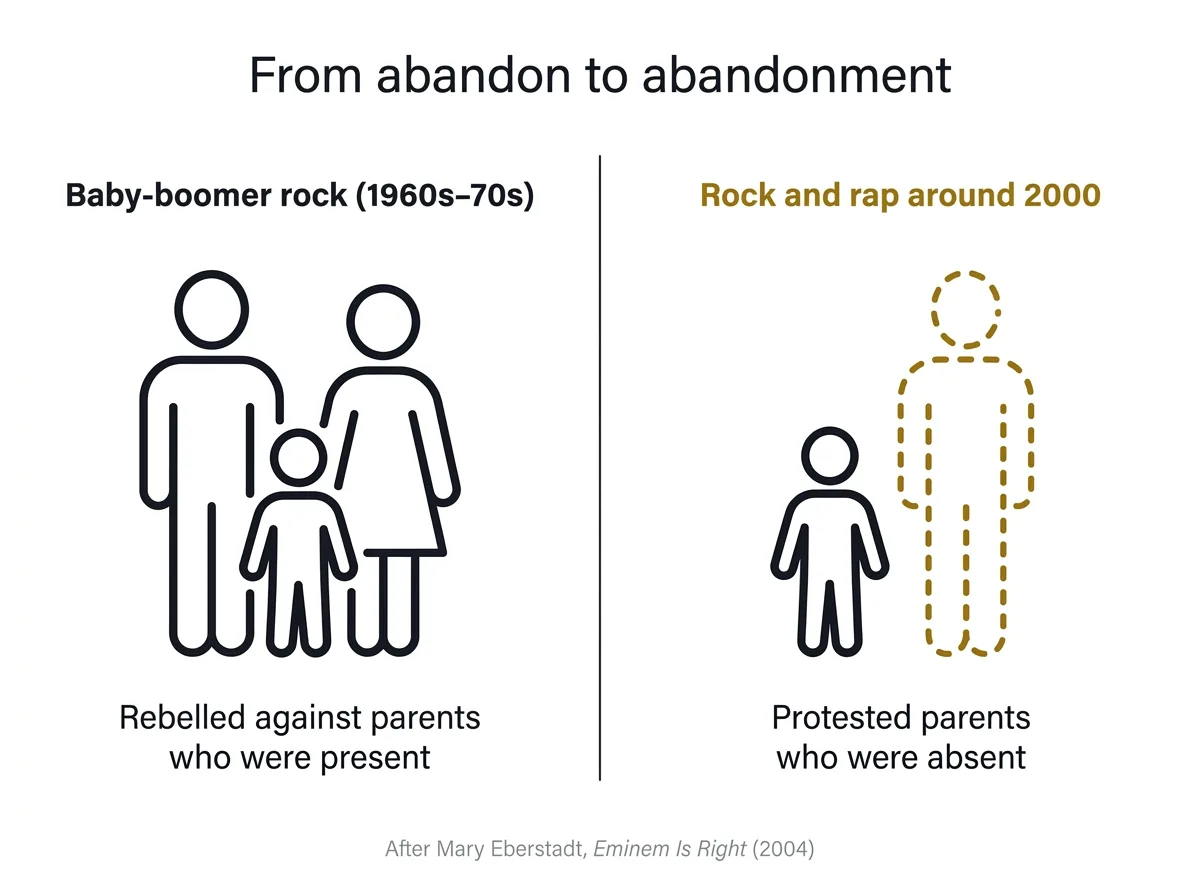
- Compare the generations. In her best-known line, “If yesterday’s rock was the music of abandon, today’s is that of abandonment.”
The title comes from her conclusion. The rapper tells critical adults to look at their own houses instead of his records, and Eberstadt finds the messenger absurd but the message partly true: “In this limited sense at least, Eminem is right.”
The case: who was singing for the kids left behind
Most of the essay is a tour of the charts in the years around 2000. Eberstadt chose award-winning top-40 performers, along with a few older stars, so that nobody could dismiss the pattern as a niche taste. They are not obscure names.
| Artist | Example she discusses | Theme |
|---|---|---|
| Papa Roach | “Broken Home” (*Infest*, 2000) | A son unsure his father cares |
| Everclear | “Father of Mine”, “Wonderful” | Divorce seen by the child |
| Blink-182 | “Stay Together for the Kids” (2001) | Parents who split anyway |
| Pink | “Family Portrait” | A daughter begging a father to stay |
| Good Charlotte | Songs by the Madden twins | A father who walked out |
| Tupac Shakur, Snoop Dogg, Jay-Z | Songs about fathers | Anger at a missing dad |
| Eminem | “Cleaning Out My Closet”, “8 Mile” | Abandonment told by the child |
She also reaches back to Kurt Cobain of Nirvana, whose parents divorced when he was seven, and to Eddie Vedder of Pearl Jam, who, she notes, was struck that so many fans identified with what both men wrote. The music journalist William Shaw had described the same mood in *Blender* in 2002.

Why this rapper gets the title
By the essay’s count, *The Eminem Show* sold more than 7.6 million copies in 2002, the year’s biggest album. Its author was also one of the most criticized stars of the time, drawing objections from feminist and gay-rights groups as well as from social conservatives.
Yet his verses, Eberstadt argues, keep returning to a child’s grievance: an absent father, a troubled mother, a younger sibling he wants to protect. She reads even his ugliest lines about women as aimed mostly at his mother and ex-wife, as rage at failed mothering. They are not, in her reading, random hatred. She still finds them indefensible, but treats them as evidence about the families the fans came from.
Context: where the essay came from
The essay is drawn from Eberstadt’s book *Home-Alone America: The Hidden Toll of Day Care, Behavioral Drugs, and Other Parent Substitutes* (Sentinel, 2004), where it is the chapter “Ozzie and Harriet, Come Back! The Primal Scream of Teenage Music.” At the time she was a research fellow at the Hoover Institution, a think tank at Stanford.
The book argues that children in the United States were spending less time with the adults who raised them than any earlier generation, because of divorce and single parenthood and the rise of two-career households. Other chapters deal with day care, teen mental health and behavioral drugs, and sexually transmitted diseases among unsupervised teens. All the other chapters lean on statistics; the music chapter rests on testimony.
The change in family structure itself has been well documented. A Pew Research Center analysis found that 46% of U.S. children lived with two married parents in their first marriage, down from 73% in 1960.
Reception and criticism
Reviews of the book differed. Conservative and religious outlets welcomed the music chapter as fresh evidence. The reviewer in the Jesuit magazine *America* called the book “provocative, even polemical,” while agreeing that the separation of children from parents had reached unprecedented levels.
Critics have raised several objections:
- Testimony is not data. Eberstadt concedes that the damage she describes is hard to measure, and a handful of famous artists cannot show what happens to most children of divorce.
- Lyrics are performances. Rap and rock personas exaggerate by design, so a song about a cruel father is not a sworn account.
- Family change need not mean harm for the young. Historians and sociologists such as Stephanie Coontz, whom the essay names as a foil, argue that changes in marriage and family life are not in themselves a problem. On this view children need stability and support, which many single-parent and blended families provide.
- Divorce research is mixed. Judith Wallerstein’s long-term work stressed lasting harm; E. Mavis Hetherington found that most children of divorce grow into well-functioning adults, though a minority struggle more than their peers.
Eberstadt’s reply to the first point is built into the essay: statistics measure outcomes, while the songs record how the experience felt to those who lived it.
How it has held up
Two decades on, readers treat the essay both as cultural criticism and as a period piece. Some of the bands it names now fill nostalgia playlists, and listeners still argue over whether their songs were autobiography or pose. In recent years, debates about fatherless homes and youth mental health have kept the question open.
The idea itself stayed with Eberstadt. In *Primal Screams: How the Sexual Revolution Created Identity Politics* (2019) she argued that family breakdown leaves people searching for identity elsewhere. Readers and reviewers remain divided on that thesis; “Eminem Is Right” is one of her best-known arguments for reading pop culture as testimony about the American family.
Readers’ questions
What is the essay Eminem Is Right about?
It argues that much popular music around 2000 dwelt on divorce and absent parents, and that its huge teenage audience suggests listeners felt the same.
Did Eberstadt defend the lyrics?
No. She criticizes the lyrics sharply. She argues only that he has a point when he blames empty houses.
What book is the essay from?
*Home-Alone America* (2004), where it forms the chapter on teenage music.
Where to read the original
The essay appeared in *Policy Review* No. 128, December 2004 and January 2005. The Hoover Institution keeps it in its archive, with the original notes: Eberstadt, “Eminem Is Right”.
Sources
- Mary Eberstadt, "Eminem Is Right", Policy Review 128 (2004)
- Mary Eberstadt, Home-Alone America: The Hidden Toll of Day Care, Behavioral Drugs, and Other Parent Substitutes (Sentinel, 2004)
- John A. Coleman, "Separation Anxiety", America (2005)
- Pew Research Center: Less than half of U.S. kids today live in a 'traditional' family (2014)
- Mary Eberstadt, Primal Screams: How the Sexual Revolution Created Identity Politics (2019)