The essay in brief
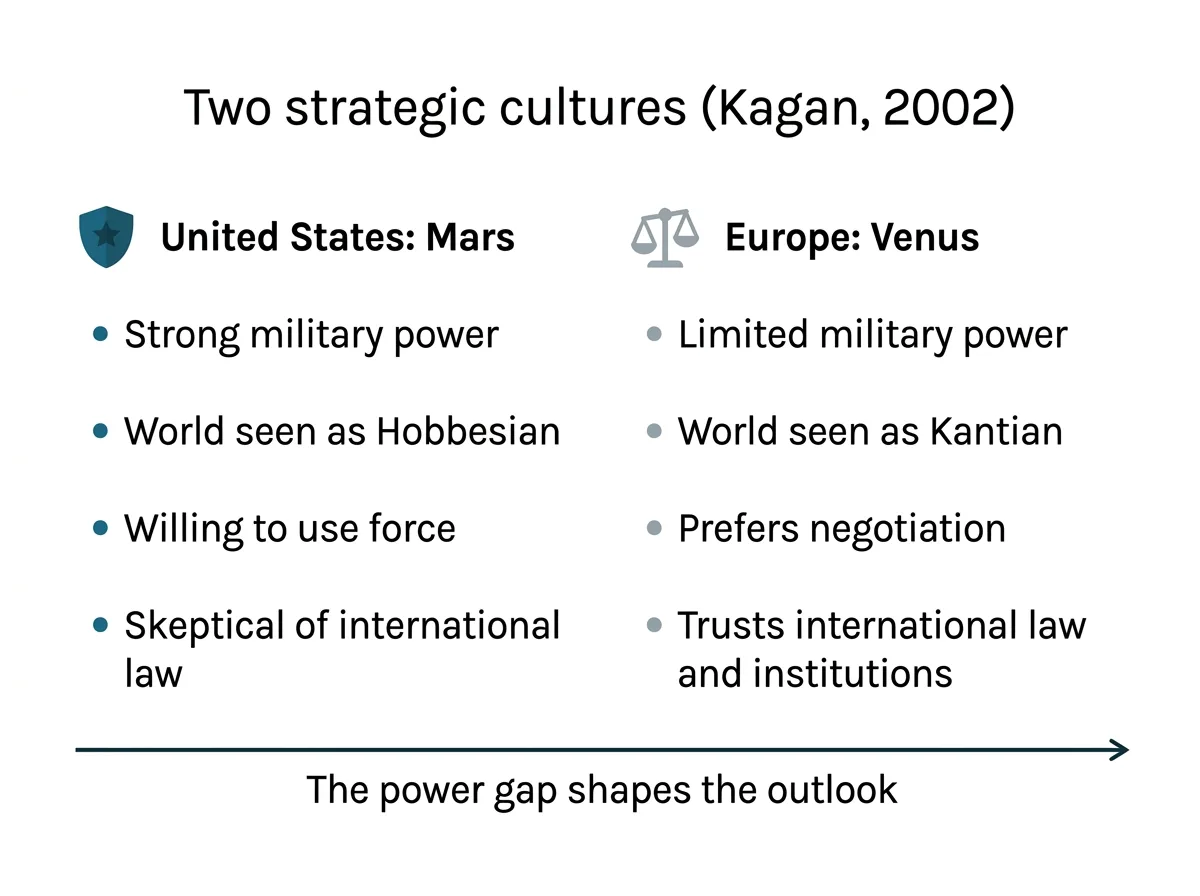
Robert Kagan argued in 2002 that Americans and Europeans see the world differently because of a gap in power: the strong are more willing to use force, the weak prefer law and negotiation. His line "Americans are from Mars and Europeans are from Venus" became shorthand for the transatlantic divide.

In June 2002, nine months after the September 11 attacks and nine months before the Iraq war, the journal *Policy Review* printed an essay by Robert Kagan called “Power and Weakness.” Within weeks it was being argued over in foreign ministries from Paris to Berlin. Its most quoted line gave the quarrel between the United States and Europe a shorthand that is still in use: “Americans are from Mars and Europeans are from Venus.”
This guide explains what Kagan argued, why the essay landed with such force, what his critics said, and how the thesis looks more than two decades later.
What is Power and Weakness about?
Kagan’s claim was that Europeans and Americans had stopped sharing a common view of the world, and that the difference ran deeper than any single government or crisis.
In his account, Europe was moving beyond power politics into a world of laws, rules and negotiation, a kind of post-historical peace that he linked to Immanuel Kant’s essay *Perpetual Peace*. America, by contrast, still operated in a Hobbesian world, in which international law was unreliable and security depended on military strength. From those two positions came different instincts about threats, about the use of force and about the value of international institutions.
The essay’s main points, in order:
- The gap between American and European views on foreign policy is real, wide and growing.
- Its main cause is a gap in power: the United States is militarily strong, Europe is militarily weak.
- Strength and weakness each produce their own psychology about what counts as a tolerable risk.
- Europe’s own history, above all two world wars and the success of European integration, reinforced a preference for law over force.
- The divergence between the United States and Europe is likely to last, and both sides would do better to accept it than to pretend it away.
Where did the power gap come from?
Kagan traced the gap through the twentieth century. The Second World War ended the European states’ role as global military powers. During the Cold War, Western Europe lived under American protection, which let European governments spend less on defense and more on welfare and integration. When the Cold War came to an end, Europe took the peace dividend, while the United States kept a military that could fight anywhere in the world.
To explain how capability shapes outlook, Kagan used an image that became almost as famous as the Mars and Venus line. A man with only a knife, he wrote, may decide that a bear in the forest is a risk he can live with, because hunting it with a knife would be more dangerous than hoping it never attacks. Give the same man a rifle and he will judge the risk differently. In Kagan’s reading, Europe tolerated threats such as Saddam Hussein’s Iraq partly because it lacked the means to act against them.
He also pointed out that the gap was older than the Bush administration. In the 1990s, the Clinton administration bombed targets in Iraq, Afghanistan and Sudan, steps that most European governments would not have taken on their own.
Why did the essay hit so hard?
Timing explains part of it. In 2002 the Bush administration was preparing for war against Iraq, and the governments of France and Germany were preparing to oppose it at the United Nations. Kagan offered both sides an explanation that did not depend on bad faith: Americans and Europeans disagreed because they stood in different places.
The essay also flattered and provoked at the same time. Europeans could read it as praise for their law-based order or as an accusation of free-riding on American power. Americans could read it as a defense of that power or as a warning that the United States might end up alone. Kagan expanded the argument into a short book, *Of Paradise and Power* (2003), which carried the debate well beyond the readership of a policy journal and into American public opinion.

What did the critics say?
The argument drew strong objections, many of them printed in *Policy Review* itself.
| Criticism | The point |
|---|---|
| Power is more than military force | Europe’s weight in trade, aid, regulation and diplomacy is real power, even without aircraft carriers. |
| Europe is not one actor | Britain, France and Poland held views on force much closer to Washington’s than Germany’s did. |
| History cuts both ways | The European preference for law grew out of the experience of war, not out of weakness alone. |
| The Venus label is a caricature | European troops served in the Balkans and later in Afghanistan. |
Some readers also objected to the framing itself. Describing a whole continent with one psychology, they argued, made a policy disagreement sound like a difference in national character.
Mars and Venus ten years later
For the essay’s tenth anniversary in 2012, *Policy Review* invited ten writers from the United States and Europe to reassess it, and Kagan replied to them. Several praised its insight but argued that he had treated military force as the only kind of power that counts. Others noted that the transatlantic rift of 2003 had partly healed under the Obama administration, even though defense budgets in Europe had not grown.
Taken together, the contributors’ verdict was mixed. Many held that Kagan’s description of the gap still fit, while his prediction that it would keep widening looked less certain to them.
How has Kagan’s thesis held up since?
Supporters of the thesis note that the 2003 split over the Iraq war ran largely along the lines Kagan described, and for years European defense spending stayed low while the United States carried most of NATO’s military weight.
Other parts look different after 2014 and especially after Russia’s full invasion of Ukraine in February 2022. European governments sharply increased defense spending, and Germany announced a special fund of 100 billion euros for its armed forces. According to NATO’s figures on defence investment, European Allies and Canada raised their defense spending from 1.4 percent of combined GDP in 2014 to 2.3 percent in 2025, and at the 2025 Hague summit the Allies agreed to aim for 5 percent of GDP by 2035.
Defenders read that shift as support for Kagan’s deeper claim that capabilities shape outlook: once Europe faced a direct military threat, its view of force changed. Critics see it as a challenge to his prediction that the divergence would endure, because the gap narrowed through Europe moving toward Mars rather than America moving toward Venus.
How to read the essay today
If you read “Power and Weakness” now, three questions help. First, ask what Kagan meant by power: there are passages where he means only military power, and you have to decide whether that narrow definition still fits a world shaped by trade, technology and sanctions. Second, compare his account of European history with what European governments have done since 2022; they have raised defense spending, and you can test whether their view of force changed with their means. Third, notice how often the essay speaks of “Europe” and “America” as single actors. Then ask which governments, parties and parts of public opinion on each side actually held the views he describes.
Is Robert Kagan a neoconservative?
He is usually counted among the heirs of the neoconservative movement that grew up around *Commentary*, above all for his writing in the late 1990s and 2000s. Kagan co-founded the Project for the New American Century with William Kristol in 1997. He later broke with the Republican Party and has written widely on American foreign policy and the world order since.
What is Of Paradise and Power?
It is Kagan’s 2003 book that expands the essay into a longer argument about the relationship between Europe and America. The title takes up the essay’s contrast between a European “paradise” of rules and an American world of power.
Where can I read the original essay?
“Power and Weakness” appeared in *Policy Review* No. 113, June and July 2002. The full text remains available in the Hoover Institution’s Policy Review archive. This guide is new writing about the essay; it summarizes the argument in our own words and quotes only its best-known line.
Sources
- Robert Kagan, "Power and Weakness", Policy Review 113 (2002)
- Robert Kagan, Of Paradise and Power: America and Europe in the New World Order (Knopf, 2003)
- Policy Review: Mars and Venus, Ten Years Later, editor's note (2012)
- Robert Kagan, "On Power and Weakness", Brookings
- NATO: Defence investment and NATO's 5% commitment