The essay in brief
Lee Harris argued in 2002 that the most radical anti-Americanism grew out of a revision of Marxism: when Western workers prospered, theorists such as Paul Baran and Immanuel Wallerstein moved the source of revolutionary misery to the Third World and cast America as its cause. Judged by Marx's own realism, Harris called this a fantasy ideology.

Why would some writers in the West greet the attacks of September 11 as a blow for justice? Lee Harris put that puzzle at the center of “The Intellectual Origins of America-Bashing,” published in *Policy Review* No. 116 (December 2002 and January 2003). His answer reached past any single American policy. In his view, a whole picture of America as the cause of misery in the rest of the world grew out of an attempt to rescue Marxism after its central prediction failed.
The problem Harris wanted to explain
Harris drew a line between criticism and condemnation. People can object to a war, a tariff or a treaty and still believe the United States is capable of change. There is nothing unusual about that. What interested him was something more sweeping: a total judgment against the country that sees no real difference between parties or eras and treats all the acts of American governments as part of a single design of oppression.
He opened with examples from his own moment:
- Salman Rushdie, writing in the *Guardian* in February 2002, on an anti-Americanism that was “taking the world by storm.”
- Martin Kettle’s *Washington Post* essay on how fashionable US bashing had become in European opinion.
- Noam Chomsky’s repeated description of America as a leading terrorist state.
- An email by the playwright Dario Fo, quoted in the *New York Times*, that set the dead of September 11 against deaths from poverty in poor countries.
This mood was not confined to a few authors. A Pew Global Attitudes survey of 44 nations found that favorable views of the United States had fallen in 19 of the 27 countries with trend data since 2000 (Pew Research Center, What the World Thinks in 2002). But Harris cared more about ideas than about polls. He wanted to know where the theory behind the hardest form of anti-Americanism came from, and why it had such a hold on those who held it in our time.
Causes: why Marxism needed a new source of misery
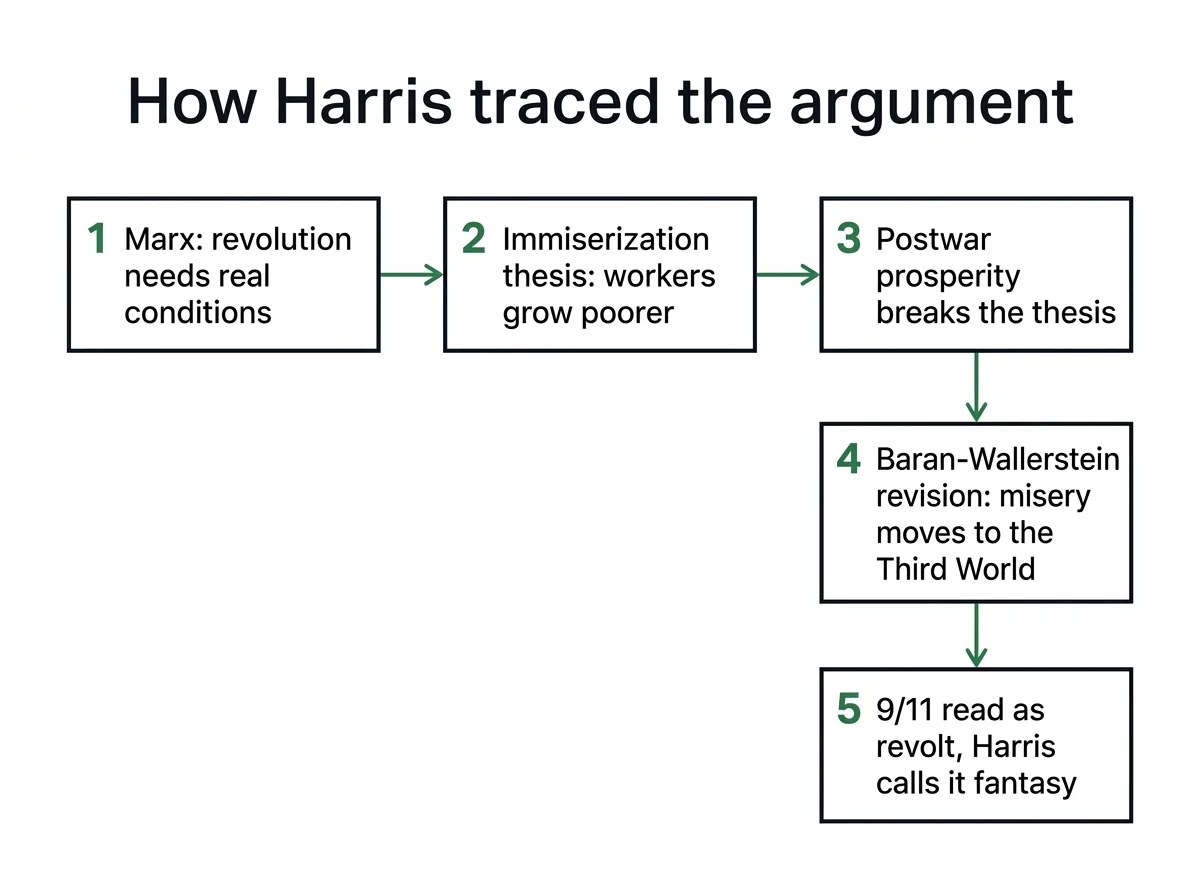
His genealogy runs in four steps.
- Marx as a realist. Marx and Engels mocked earlier socialists as utopians. This claim to be scientific rested on showing how revolution would grow out of real conditions, and not out of good intentions alone.
- Misery as the engine. In the classical account, the working class revolts only when it grows poorer and expects to grow poorer still. Harris called this the immiserization thesis.
- Prosperity as the problem. In the 20th century, and above all after the Second World War, which brought the great postwar boom, wage earners in advanced capitalist countries did well and expected their children to do better. They were hardly the revolutionaries the theory required.
- Moving misery abroad. Paul Baran’s *The Political Economy of Growth* (1957) argued that rich countries grew rich by keeping poor ones poor. Immanuel Wallerstein’s *The Modern World-System* (1974) set this claim in a long historical frame. Harris named the result the “Baran-Wallerstein revision.”
Once misery was relocated to the Third World, the United States stood at the hub of a global system as its chief beneficiary. Its armed forces looked like the tool that kept that system in place. Factory hands in Ohio or the Ruhr no longer mattered much to the theory, and a comfortable American employee could even be counted among the oppressors.
| Step | Classical Marxism | Baran-Wallerstein revision |
|---|---|---|
| Who suffers | Industrial labor at home | Poor nations abroad |
| Who exploits | A national capitalist class | Rich nations, America first |
| Path to change | Civil war inside one society | Revolt of the periphery |
| Test of realism | Can the class seize the state? | Not addressed |

Harris’s answer: judge the revision by Marx’s own standard
Here the essay turns. Harris did not try to settle whether rich countries really cause poverty in poor ones. He said this question was too large for an essay and granted the thesis for the sake of argument, but only for that purpose.
Even if it were true, he wrote, it could not save Marxism. Marx imagined a struggle inside a society, where an exploited class could take over the state with the numbers on its side. Poor nations facing rich ones that hold overwhelming force are in a very different position, with far less leverage than the class Marx described. In Harris’s phrase, they could not alter the order of things “by even a hair” if the advanced countries were set against it.
This is why he called the revision a fantasy ideology, a term he developed in “Al Qaeda’s Fantasy Ideology” a few months earlier in the same journal. A fantasy ideology treats real events as a stage for a dream. The attacks of 2001 tempted some radicals to read them as a second storming of the Bastille. Harris replied that the comparison fails on its own terms. The first point is that the French crowd of 1789 saw the Bastille as a symbol of its own oppression, and its fall weakened a monarchy from within. The attacks, he argued, did the opposite of what the radicals predicted. They united the American people, wage earners most of all, behind their government. A society whose bumper stickers said “United We Stand,” he wrote, was no breeding ground for revolution.
He closed with a phrase from Raymond Aron: this kind of thinking had become an opium, one that produces vivid fantasies of the most comforting kind.
Context: the year before the Iraq war
The essay appeared as transatlantic quarrels over American power were sharpening. Robert Kagan’s “Power and Weakness” had run in *Policy Review* earlier in 2002, and the debate over Iraq and the Middle East was reaching its peak. Michael Hardt and Antonio Negri’s *Empire* (2000) had given radical critics a new vocabulary, and Harris read it as one more revision of historical materialism. He later expanded these themes in *Civilization and Its Enemies* (2004).
Reception and criticism
Readers on the right took the essay as an account of why some critics seemed unmoved by Islamist violence. Critics raised points that any careful reader can weigh:
- Hostility to American culture has older roots, in European Romanticism and in conservative critiques of commerce and mass society, which owe nothing to Marx.
- Dependency theory and world-systems analysis are research programs with debates of their own, and many scholars who use them never endorsed the readings of September 11 that Harris attacked.
- Grouping Chomsky, Fo and academic theorists together may blur differences that matter, since other writers on the left argued against the readings Harris described.
- Hardt and Negri described a global order with no single national center, so putting America at its hub is itself a contested reading.
How well has it held up?
Admirers point to his central test: a theory of revolution needs an agent that can actually win, and the attacks did not set off the breakdown that such a theory required. They also note that his warning about harsher security measures, including racial profiling, anticipated later debates over surveillance.
Critics consider the genealogy weaker as a full history. Many scholars describe several strands of anti-Americanism, cultural, economic and political, some going back to European debates of the 19th century. Read as an account of one strand, the essay is still widely cited in the history of ideas.
Readers’ questions
What is the immiserization thesis?
The idea, drawn from Marx, that capitalism makes workers steadily poorer until they feel that they have nothing to lose and revolt. Harris argued that postwar prosperity refuted it.
What is the Baran-Wallerstein revision?
Harris’s name for the shift that moved misery from the Western working class to poor nations and cast rich countries as the exploiters.
Was Harris attacking Marx?
Not exactly. He used Marx’s insistence on realism as the yardstick and argued that later radicals, not the founder, were at fault because they had dropped it.
Where to read the original essay
The full text is in the Hoover Institution’s *Policy Review* archive: Lee Harris’s essay at the Hoover Institution. It reads well alongside his earlier piece on al Qaeda, since the two make one argument about political fantasy after September 11.
Sources
- Lee Harris, "The Intellectual Origins of America-Bashing", Policy Review 116 (2002)
- Lee Harris, "Al Qaeda's Fantasy Ideology", Policy Review 114 (2002)
- Pew Research Center, What the World Thinks in 2002
- Lee Harris, Civilization and Its Enemies (Free Press, 2004)