Security
War, deterrence, terrorism and the private armies in between.
4 concepts explained · 3 essay guides
Left: closer to domestic politics. Up: closer to theory. Placement is orientation, not judgement.
Placement: Policy Review editors, reviewed October 2026.
Concepts in this field
- Mercenaries: Who Fights for Pay, and Why the Law Struggles to Say Mercenaries are soldiers who join an armed conflict mainly for private gain, serving a state or group other than their own without belonging to…
- Mutually Assured Destruction: The Conditions That Make It Work Mutually assured destruction (MAD) is the condition in which two nuclear-armed states can each destroy the other even after absorbing a surprise attack. Because…
- Terrorism Definition: Why One Word Is So Hard to Pin Down Terrorism is the use or threat of violence, usually aimed at civilians, to spread fear and push a government or a public toward a…
- What Is a Failed State? Definition and a Four-Test Framework A failed state is a country whose government can no longer perform the basic functions of a state: keeping order, holding its territory and…
Essay guides in this field
- The Terrorism to Come: Walter Laqueur on the Next Threat In 2004 Walter Laqueur argued that poverty does not explain terrorism, that settling local conflicts would not stop global jihadism, and that Europe was…
- Peacekeepers, Inc.: P. W. Singer on Privatized Peacekeeping In 2003 P. W. Singer asked whether private military firms should take over peacekeeping when governments will not send troops. He saw real gains…
- Al Qaeda’s Fantasy Ideology: Lee Harris on 9/11 as Theater Lee Harris argued in 2002 that the 9/11 attacks were not Clausewitzian war aimed at a political concession but a symbolic drama staged for…
National security sounds like a simple idea until someone asks what exactly is being secured, against whom, and at what cost. A country can be safe from invasion and still exposed to cyberattacks, pandemics or a collapsing neighbour. The explainers and essay guides listed above each take up one of those questions; the answers below give the wider picture.
What is national security?
Most definitions start with an object to protect. The classic object is the nation and its state: territory, government and the freedom to act without outside control. Later definitions add the population, the economy and the values a political community holds.
Two mid-century definitions still frame the debate:
- Walter Lippmann wrote in 1943 that a nation is secure to the extent that it is not in danger of having to sacrifice core values to avoid war, and is able, if challenged, to maintain them by victory in such a war.
- Arnold Wolfers, in a 1952 essay, called national security an “ambiguous symbol”. In an objective sense it measures the absence of threats to acquired values; in a subjective sense, the absence of fear that such values will be attacked.
Wolfers’s split between real danger and felt fear explains why the concept is contested. One nation may see a grave external threat where its neighbours see none, and much of the argument over national security policy happens in that gap.
Why does security matter to a nation?
Protection from violence is the oldest task people expect of the state. Without it, courts, schools and markets are hard to sustain.
Security also shapes how a country deals with the world. Its reading of its national interests decides which alliances it joins, how much it spends on defense and how far it trusts foreign powers.
What are the elements of national security?
Writers on the subject usually list several elements, each with its own instruments. Military security is the oldest, but most modern accounts include more.
| Element | What it protects | Typical instruments |
|---|---|---|
| Military security | territory and armed forces | defense, deterrence, alliances |
| Political security | government and constitutional order | intelligence services, counterintelligence, the rule of law |
| Economic security | trade, finance, supply chains | sanctions, export controls, stockpiles |
| Energy and resource security | fuel, food and water supplies | diversification, reserves, diplomacy |
| Cyber and information security | networks and public debate | network defense, attribution, regulation |
| Environmental and health security | climate stability, public health | international cooperation, emergency planning |
Money and attention given to one element are not available for another, so every national strategy is also a list of priorities.
What are the main threats to national security?
For most of the twentieth century the answer was armed attack by another country. After the Cold War, the list grew to include terrorism, insurgency, organised crime, the collapse of weak governments, attacks on computer networks, energy cut-offs and pandemics.
The 1994 Human Development Report of the United Nations Development Programme pushed this widening furthest. It proposed “human security”, defined as freedom from fear and freedom from want, with the individual rather than the nation as the thing protected. Supporters say this matches what actually kills people. Critics reply that if everything counts as a security issue, the concept stops guiding choices.
How do the main theories of security studies differ?
Scholars of international relations explain the same dangers in different ways. Each school offers a coherent account in its own terms:
- Realism holds that countries live in an anarchic system with no world government above them, so each must provide for its own security. Kenneth Waltz’s *Theory of International Politics* (1979) made this structure the core of neorealism. John Herz described the security dilemma, in which one country’s defensive build-up looks threatening to others, who then arm in turn. Realists see the balance of power as the main source of stability.
- Liberal institutionalism, associated with Robert Keohane and Joseph Nye, argues that trade, alliances and international institutions lower the cost of cooperation. On this view, nations can gain security together rather than only at each other’s expense.
- Constructivism, set out in Alexander Wendt’s 1992 article “Anarchy Is What States Make of It”, holds that threats depend on identities and shared ideas. Britain’s nuclear arsenal worries American planners far less than a smaller arsenal in hostile hands.
- The Copenhagen School of Barry Buzan, Ole Wæver and Jaap de Wilde (*Security: A New Framework for Analysis*, 1998) introduced securitization. An issue becomes a security matter when a leader persuades an audience that it is an existential threat that justifies extraordinary measures. The same authors split security into five sectors: military, political, economic, societal and environmental.

What is deterrence in national security?
Deterrence means preventing an attack by threatening costs the attacker will not accept. Defense tries to stop an attack once it starts; deterrence tries to make sure it never starts. Bernard Brodie argued in 1946 that nuclear weapons had made deterrence the chief purpose of military forces. Thomas Schelling’s *Arms and Influence* (1966) treated coercion as a form of bargaining in which the threat matters more than the blow.
Deterrence works only if the opponent believes the threat. The explainer on mutually assured destruction looks at what kept nuclear deterrence stable during the Cold War.
How do governments organise security policy?
Most countries combine diplomacy, intelligence, economic tools and the military, and many publish a national strategy document that sets priorities among them. In the United States, the National Security Act of 1947 reorganised the foreign policy and military establishments. It created the National Security Council, where the president, vice president, secretary of state, secretary of defense and officials such as the director of the Central Intelligence Agency meet to discuss long-term problems and immediate crises. The same act set up the CIA and formally established the Joint Chiefs of Staff, and 1949 amendments turned the new military establishment into the Department of Defense.
Each president has given the council a different degree of importance. Other countries, such as the United Kingdom, use their own models, but the coordinating idea is similar.
How does security relate to civil liberties?
Security policy always has a price, paid in money, lives or freedoms. Democracies argue over that price in courts, legislatures and the press. Recurring tensions include surveillance against privacy, emergency powers against checks and balances, and secrecy against public accountability.
Some argue that a state which cannot protect its citizens fails at its first task. Others warn that a “national security state” can erode the values it claims to defend.
Which security topics does this site explain?
The explainers in this field apply these questions to specific problems:
- Mutually assured destruction: nuclear deterrence between rival powers and what keeps it stable.
- Failed states: what happens when a government loses control of its territory, with a four-test framework for judging state failure.
- Mercenaries: who fights for pay, the six criteria in Article 47 of Additional Protocol I (1977), and the debate over private military companies.
Two essay guides add historical depth. P. W. Singer’s *Peacekeepers, Inc.* (2003) asks whether private firms could take on peacekeeping. Lee Harris’s *Al Qaeda’s Fantasy Ideology* (2002) reads the September 11 attacks as political theater rather than a conventional strategic act.
How does security connect to the other fields?
Security overlaps with every other section of this reference:
| Field | Where it meets security |
|---|---|
| Foreign policy | alliances, hard and soft power, balance of power, realpolitik |
| Law | war powers, surveillance, the international law of armed conflict |
| Economy and society | defense budgets, sanctions, globalization and supply chains |
| Ideas | competing views of the state, liberty and the use of force |
| Policy analysis | how dangers are assessed and how security programs are evaluated |
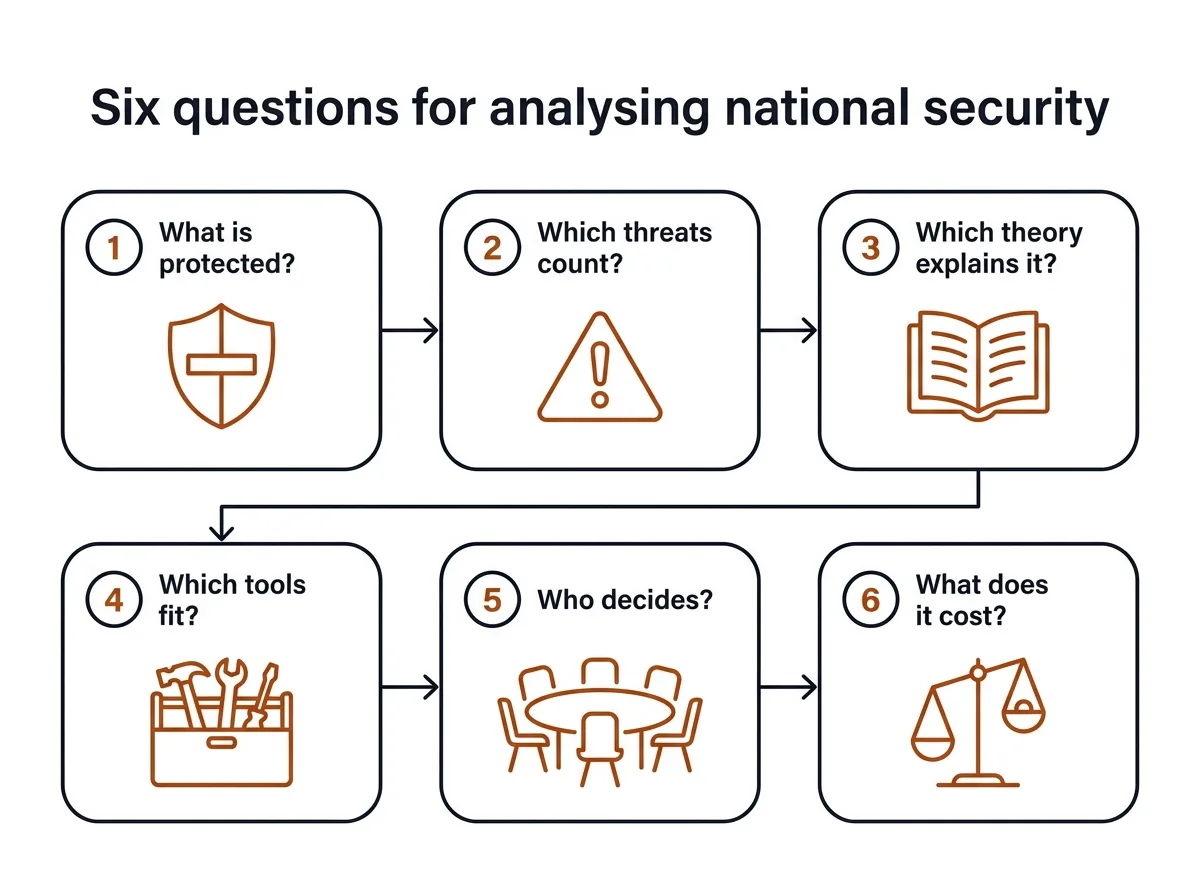
Taken together, the questions turn a vague phrase into something you can test: what is protected and from what, which theory explains the danger, which tools fit it, and what the response costs.